|
|
|
|
|
Vidin (Bulgarian: Р’РёРґРёРЅ) is a town on the southern bank of the Danube in northwestern Bulgaria. It is close to the borders with Serbia and Romania, and is also the administrative centre of Vidin Province. |
|
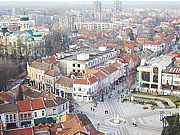 The central streets of Vidin Vidin Province is the northwesternmost province of Bulgaria. It borders Serbia and Romania.
Its administrative centre is Vidin on the Danube, and other municipalities are Belogradchik, Boynitsa, Bregovo, Chuprene, Dimovo, Gramada, Kula, Makresh, Novo Selo, and Ruzhintsi.
There are remains of many castles, some of which are Baba Vida, one of the last Bulgarian strongholds during the Turkish invasion and the Belogradchik fortress.
|
|
|
The territory of the province includes the most western parts of the Danubian Plain and Stara Planina, while the Danube forms the border with Romania. The slopes of Stara Planina are coverred with dense forests, lush meadows and boasts the majestic rock phenomena, the Belogradchik Rocks. There are around 80 caves situated close to the border with Serbia, the most famous being the Magura cave, which known with its cave painting from 10,000 BC. There is also a lake in the proximity of the cave. |
|
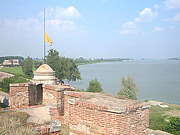 A view of the Danube from Vidin Vidin is the westernmost important Bulgarian Danube port and is situated on one of the southernmost sections of the river. A ferryboat complex, linking Vidin with Calafat on the opposite side of the river, is located 2 km from the town. The complex is to be replaced by the Calafat-Vidin Bridge.
Vidin is the 19th town by population in Bulgaria, but serious demographic problems have been experienced in the area since World War II. |
|
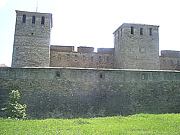 Baba Vida fortress in Vidin Vidin emerged at the place of an old Celtic settlement known as Dunonia, where a Roman fortified town called Bononia was later constructed. The town grew into one of the important centres of the province of Upper Moesia, encompassing the territory of modern northwestern Bulgaria and eastern Serbia. Roman rule lasted until 46 AD.
When Slavs settled in the area, they called the town Badin or Bdin, where the modern name comes from. |
|
|
Vidin"s main landmark, the Baba Vida fortress, was built in the period from the 10th to the 14th century.
In 1356, Bulgarian tsar Ivan Alexander isolated Vidin from the Bulgarian monarchy and appointed his son Ivan Stratsimir (1356-1396) as absolute ruler of Vidin"s new city-state. In 1365, the Despotate of Vidin was occupied by Magyar crusaders. Under Hungarian rule, the city became known as Bodony, but the occupation was short-lived. In 1369, a united Slavic Bulgarian empire drove out the Hungarian military, but in 1393 the whole of Bulgaria, along with the rest of the surrounding region, fell to the Ottoman Empire. This brought an end to Bulgaria"s medieval state empire. Vidin was now the only region controlled by the indigenous Slavic population and not the invading Ottoman Turks. |
|
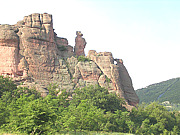 The Belogradchik Rocks The Ottomans went on to conquer the despotates of Dobrudja, Prilep and Velbazhd as well. Vidin"s independence did not last long. In 1396, Stratsimir contributed soldiers to assist the Slavic nations" bid to overturn the Ottoman Empire. Following defeat at the hands of the Ottomans outside the city of Nicopolis, Vidin finally fell under the sphere of the Ottomans, led by Bayezid I, as a punishment for their role in the hostilities.
In the late years of Ottoman rule, Vidin was the centre of Turkish rebel Osman Pazvantoglu"s breakaway state. |
|
|
|










 Sofia