|
|
|
|
|
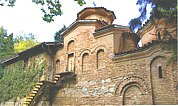
Veliko Tarnovo (Bulgarian: Велико Търново; also transliterated as Veliko Turnovo is a city in central northern Bulgaria and the administrative centre of Veliko Tarnovo Province.
It is located on the Yantra River and is famous as the historical capital of the Second Bulgarian Empire, attracting many tourists with its unique architecture. |
|
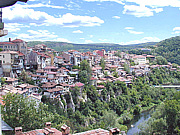 Veliko Tarnovo Veliko Tarnovo is a province in the middle of the northern part of Bulgaria. Its capital city, Veliko Tarnovo, is of historical significance as it is known as the capital of Medieval Bulgaria.
Other towns in the province include Gorna Oryahovitsa, which is within 10 kilometres of Veliko Tarnovo, Svishtov, set on Danube River and famous for its Tsenov Academy of Economics, and Suhindol, the hometown of Lovico — an internationally recognised label for fine wines and spirits.
Another notable place is the village of Arbanasi, set between Veliko Tarnovo and Gorna Oryahovitsa. The combination of old style and modern architecture, as well as its churches and monasteries, present the spirit of Bulgaria. Real estate is among the most expensive in the country. |
|
History - Prehistory and Antiquity |
|
Veliko Tarnovo is one of the oldest settlements in Bulgaria, having a history of more than 5 millennia, as the first traces of human presence dating from the 3rd millennium BC are on Trapezitsa Hill.
|
|
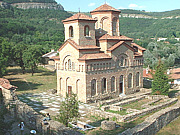 Tsarevets The historical part of town, which was the capital of Bulgaria during the Second Bulgarian Empire, lies on three hills – Tsarevets, Trapezitsa and Sveta Gora (Holy Mountain). Veliko Tarnovo is the place where brothers Asen and Peter declared the end of Byzantine rule in Bulgaria, proclaiming the city a capital.
Veliko Tarnovo grew quickly to become the strongest Bulgarian fortification of the Middle Ages between the 12th and 14th century and the most important political, economic, cultural and religious centre of the empire. In the 14th century as the Byzantine Empire weakened Tarnovo claimed to be the Third Rome based on its preeminent cultural influence in the Balkans and the Slavic Orthodox world. |
|
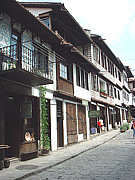 Samovodska Charshiya Street in the Old Town The city flourished and grew for 200 years until falling to the Ottoman Empire on 17 July 1393 after a three-month siege, the fortress on the hill being eventually destroyed.
Veliko Tarnovo, known in the Middle Ages as Tarnovgrad (Търновград), was the location of two uprisings against Ottoman rule, in 1598 (the First Tarnovo Uprising) and 1686 (the Second Tarnovo Uprising), both of which failed to liberate Bulgaria.
Tarnovgrad, along with the rest of present-day Bulgaria, remained under Ottoman rule until the 19th century, when national identity and culture reasserted themselves as a strengthening resistance movement. The idea of the establishment of an independent Bulgarian church and nation motivated the 1875 and 1876 uprisings in town. On 23 April 1876, the April Uprising marked the beginning of the end of the Ottoman occupation. It was soon followed by the Russo-Turkish War (1877–1878). |
|
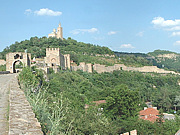 Tsarevets On 7 July 1877, Russian general Joseph Vladimirovich Gourko liberated Veliko Tarnovo, ending the 480-year- rule of the Ottoman Empire. In 1878, the Treaty of Berlin created a Principality of Bulgaria between the Danube and the Stara Planina range, with its seat at the old Bulgarian capital of Veliko Tarnovo.
On 17 April 1879, the first National Assembly convened in Veliko Turnovo to ratify the state"s first constitution, known as the Tarnovo Constitution, the key result of which resulted in the transfer of Parliament from Tarnovgrad to Sofia, which today remains the Bulgarian capital.
In deference to the city"s past, Tsar Ferdinand Saxe-Coburg Gotha chose the St Forty Martyrs Church in Veliko Tarnovo as the place to declare the complete independence of Bulgaria on October 5, 1908.
In 1965, the city, then officially known as Tarnovo, was renamed to Veliko Tarnovo (Great Tarnovo) to commemorate its rich history and importance. |
|
|
|







 Sofia