|
|
|
|
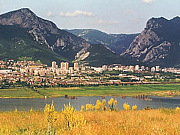 Vratsa Vratsa (also transliterated as Vraca or Vratza, in some languages with a W; Bulgarian: Враца) is a city in northwestern Bulgaria, at the foothills of the Balkan Mountains. It is the administrative centre of Vratsa Province.
The city of Vratsa is a commercial and crafts centre and a railway junction. Vratsa has textile, metal processing, chemical, and ceramics industries. It was an administrative and garrison city under Ottoman rule (15th–19th century). The municipal area of the city is inhabited by 80,040 people (as of 2004). |
|
|
Vratsa is a province of north western Bulgaria, neighbouring Romania. Its main city is Vratsa, and other municipalities are Borovan, Byala Slatina, Hayredin, Kozloduy, Krivodol, Mezdra, Miziya, Oryahovo, and Roman.
The region is bordered to the north by the Danube, and to the south by Sofia Province. It has an area of 3,621.8 sq.km. The population of 235,189 inhabitants is distributed over 10 municipalities. |
|
|
The city of Vratsa is one of the most picturesque cities in the country. It is nestled in the foothills of "Vrachanski Balkan" (Vratsa Mountain), with the Leva River calmly crossing the city and with fearful rocks overhanging the roofs. The city is only 116 km from the Bulgarian capital Sofia. |
|
|
The area has very diverse and attractive natural features, which together with the recreation opportunities gives the special charm of the Eastern part of the Northwest Bulgaria. On the territory of the State Forestry territory Vratsa are located several protected natural attractions and historical monuments. |
|
|
Vratsa is an ancient city founded by the ancient Thracians. Vratsa was called Valve ("door of a fortress") by the Romans due to the narrow passage where the main gate of the city fortress was located. Nowadays this passage is the symbol of Vratsa and is present on the city"s coat of arms.
After the fall of Rome, Vratsa became part of the Eastern Roman Empire (Byzantium).
In the end of the 6th century, Vratsa was populated by the South Slavic tribes who came from Pannonia and Dacia from the north, but reimained under Byzantine rule. |
|
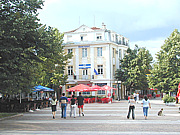 Street scene from Vratsa In the 7th century, the Bulgars and the Slavs founded the Bulgarian state and the Slavic Vratsa became part of it. The city grew into an important strategic city because of its proximity to the south state border. The name of the city was changed from Valve to the Slavic Vratitsa, which has the same meaning and is the source of the modern name. Vratsa became famous for its goldsmith"s and silversmith"s production and trade, high-quality earthenware and military significance.
In the 8th century, the Bulgarian army captured Sofia, which led to the decreasing of Vratsa"s importance because of the better strategic position of Sofia, its more developed economy and larger size. But Vratsa was again key for the resistance against the Byzantine, Serbian and Magyar invaders during the Middle Ages. |
|
|
The mountains and forests are suitable for the development of different tourism types — hunting and fishing, skiing, spelaeological, delta-gliding, photo-tourism, etc.
Good opportunities exist for exercising different sport activities such as mountaineering, bicycle sport and for those who enjoy being thrilled can go for delta and paraplaner, or set out for carting, buggy and motocross racing tracks. |
|
|
Conditions are provided for rest and entertainment — children"s and adults" swimming pools, water cycles, discos, bars, restaurants, excellent hotel facilities and good service. If you are a fervent admirer of winter sports you will be glad to hear that the rope lines near the Parshevitsa Chalet are working, and the skiing tracks are well maintained. There exist a Museum of History and an Ethnographic and Revival Complex.
Vratza is a small, but very beautiful town and you are WELCOME in it.
Look this picture to see Vratza"s Beauty!!! |
|
|
|







 Sofia