|
|
|
|
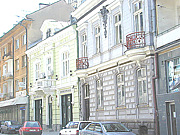 Houses of the late 19th-early 20th century in Gabrovo"s central part Gabrovo (Bulgarian: Габрово) is a town in central northern Bulgaria, the administrative centre of Gabrovo Province.
It is situated at the foot of the central Balkan Mountains, in the valley of the Yantra River, and is known as an international capital of humour and satire (see Gabrovo humour), as well as noted for its Bulgarian National Revival architecture.
Gabrovo is also known as the longest town in Bulgaria, stretching over 25 km along the Yantra, yet reaching only 1 km in width at places.
Near Gabrovo is located the geographic center of Bulgaria - Uzana. |
|
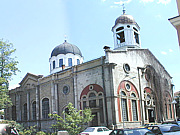 The Bulgarian National Revival church of Gabrovo, an architectural monument Bozhentsi is preserved as an old village museum. There is an ethnographic open air museum, Etara, nearby. Strung out along the valley, with its clear bubbling stream and rich bird-life, the Etara complex has the look and feel of a film set, and even though it is artificial, it is nonetheless convincing and a joy to explore.
Traditionally crafts were inseparable from the charshya (bazaar), and the reconstructed bazaar of the type once common in Bulgarian towns forms the heart of the open air museum. Throughout much of the day artisans are at work here, hammering blades, throwing pots, carving bowls and the like, and everything they make is for sale.
Note that many of the artisans leave an hour or so before the complex officially closes. |
|
|
Even if your interest in crafts is minimal it’s difficult not to admire the interiors of the old houses, which achieve great beauty through the skilful use of simple materials. Besides dwellings and workshops, the bazaar includes a couple of places for grabbing a quick drink, including a traditional cafe, and a bakery selling Turkish Delight and many other sweet treats.
An hour or so walk southwest from Etara, Sokolsky Monastery perches on a crag above the village of Voditsi. During Ottoman times the monks offered succour to Bulgarian outlaws and an assembly point during the uprising against the Turks in 1876. Nowadays it is a discreet, little-visited place, with rosebushes and privet shrubs laid out in a courtyard dominated by an octagonal stone fountain. |
|
|
The area around Gabrovo, inhabited since the Neolithic, gained economic importance after Veliko Tarnovo became capital of the Second Bulgarian Empire in the 12th century. Craftsmanship and trade prospered due to the proximity to both the capital and the Balkan passes. Medieval Gabrovo was a small pass village of about 100 houses.
According to the most widespread legend, Gabrovo was founded by a young blacksmith called Racho, close to whose fireplace a hornbeam (габър, gabar in Bulgarian) rose, so the settlement acquired its name.
|
|
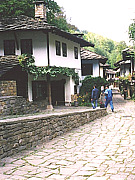 View of the Etara complex After the Ottoman invasion of the Balkans in the 14th century, the demographic position of Gabrovo changed significantly, as it was the only settlement in a considerably large geographic area and an attractive place for Bulgarians fleeing from the conquered capital and neighbouring fortresses. It turned from a village into a small town (palanka) and began to develop as an economic, cultural and spiritual centre.
During Ottoman rule, the rich tradesmen spent plenty of resources for the small town"s public planning. The first Bulgarian secular school, the Aprilov Gymnasium, was founded in Gabrovo in 1835 with the aid of Vasil Aprilov and Nikolay Palauzov. Gabrovo was officially proclaimed a town by the Ottoman authority in May 1860.
|
|
|
Shortly before and after the Liberation of Bulgaria in 1878, Gabrovo developed as a centre of industry on the basis of its economic traditions. Joint-stock companies emerged, factories were constructed and connections to the large stock exchanges were created, prompting some to label the town "The Bulgarian Manchester". |
|
|
Places of interest in Gabrovo include House of Humour and Satire and Aprilov High School. In Gabrovo Province sites include architectural reserve Bozhentsi, Ethnographic Complex Etara, Dryanovo Monastery and Sokolski Monastery. Uzana, a local winter resort is some 22 km away. Hiking is widely available in the Central Balkan National Park. For admirers of historical tourism Shipka Memorial is a must-see. |
|
|
|







 Sofia